
Result
Overview:
We evaluate the forecasting accuracy of each case by comparing the predicted typhoon tracks against the true MAYSAK (2020) track using RMSE (km).
Modeling Results
Case A
Linear Extrapolation
Case B
LSTM based Imputation
![[결측치 40] 선형보간.png](https://static.wixstatic.com/media/54f890_776f99893ba24417bc88bd74a13ed836~mv2.png/v1/fill/w_980,h_841,al_c,q_90,usm_0.66_1.00_0.01,enc_avif,quality_auto/%5B%EA%B2%B0%EC%B8%A1%EC%B9%98%2040%5D%20%EC%84%A0%ED%98%95%EB%B3%B4%EA%B0%84.png)
![[결측치 60] LSTM.png](https://static.wixstatic.com/media/54f890_7bafec2b6a774746a1dff9b6925e36dc~mv2.png/v1/crop/x_0,y_2,w_841,h_695/fill/w_841,h_695,al_c,q_90,enc_avif,quality_auto/%5B%EA%B2%B0%EC%B8%A1%EC%B9%98%2060%5D%20LSTM.png)
a. Trajectory prediction with 40% Missing Value
c. Trajectory prediction with 40% Missing Value
![[결측치 60] 선형보간.png](https://static.wixstatic.com/media/54f890_c82a0924452f47b6b548a3ae6eade394~mv2.png/v1/crop/x_0,y_1,w_996,h_850/fill/w_980,h_836,al_c,q_90,usm_0.66_1.00_0.01,enc_avif,quality_auto/%5B%EA%B2%B0%EC%B8%A1%EC%B9%98%2060%5D%20%EC%84%A0%ED%98%95%EB%B3%B4%EA%B0%84.png)
![[결측치 40] LSTM.png](https://static.wixstatic.com/media/54f890_cf41e4ecf86b4c26a9bf5e9531ae7d19~mv2.png/v1/fill/w_841,h_701,al_c,q_90,enc_avif,quality_auto/%5B%EA%B2%B0%EC%B8%A1%EC%B9%98%2040%5D%20LSTM.png)
b. Trajectory prediction with 60% Missing Value
d. Trajectory prediction with 60% Missing Value
Legend Explanation
Full Actual Path

: The projection of the raw, ground-truth data representing the actual track of Typhoon Maysak.
Full Actual Path
Input Data


: The observed data points intentionally retained for the model, excluding the sections designated as missing (gaps).
Full Actual Path
Full Actual Path
Full Actual Path
Full Actual Path
Full Actual Path
Background

: An artificially generated background field created by applying intentional error values (perturbations) to the missing data segments.
Full Actual Path
Full Actual Path
Full Actual Path
Full Actual Path
Full Actual Path
Prediction

: The reconstructed path generated by filling the data gaps using linear extrapolation or LSTM deep learning models.
Full Actual Path
Full Actual Path
Full Actual Path
Full Actual Path
Full Actual Path
Final EnFK Result

: The optimized typhoon track prediction achieved by performing an Ensemble Kalman Filter (EnKF) data assimilation on the background field and the interpolated observations.
Quantitative Evaluation (RMSE)

Case A (Linear Extrapolation) RMSE

Case B (LSTM) RMSE
Interpretation of RMSE result
Case A — Linear Extrapolation
At 40% missing data, the linear model performed efficiently (Total Track Error: 0.9819). However, when the gap increased to 60%, the Lat RMSE surged from 1.1774 to 9.714 — revealing its inability to capture nonlinear typhoon dynamics. EnKF reduced the error by 27.10%, but the final Total Track Error remained high at 7.7215. This confirms that when input observations are severely distorted, EnKF correction alone cannot overcome the physical limitations of linear extrapolation.
Case B — LSTM-based Imputation
The LSTM model maintained stable performance even at 60% missing data, achieving a Lat RMSE of 0.928 after EnKF — 7.5 times more accurate than the linear model (7.042). The Total Track Error was 3.7694, less than half of Case A. This demonstrates that the LSTM learns temporal patterns from historical data and reconstructs physically plausible trajectories, further refined by EnKF's dynamic correction.
Overall Comparison
The optimal strategy depends on data availability. With low data loss (40%), linear extrapolation is sufficient. With severe data loss (60%), the LSTM + EnKF hybrid is far superior — combining learned temporal patterns with physics-based state estimation for reliable track reconstruction.


.png)
Combining "learned temporal pattern information" with a "physics-based state estimation system" enables reliable typhoon track reconstruction even in extremely data-sparse environments. The LSTM + EnKF hybrid provides significantly greater robustness and stability than conventional interpolation-based methods.
Overall Conclusion of the Study
Linear extrapolation
LSTM-based imputation
Relies on simple geometric calculations, unable to account for physical factors like inertia or atmospheric pressure.
Learns temporal patterns from historical typhoon data, capturing non-linear dynamics in trajectory prediction.
Strength
Computationally efficient; performs well at low missing-data ratios where the trajectory remains relatively linear (40% gap → Total Track Error 0.98)
Strength
Captures general climatological tendency and non-linear recurvature patterns; remains stable under severe data loss (60% gap → Total Track Error 3.77, less than half of Case A)
Limitation
Cannot capture non-linear dynamics; highly sensitive to gap location at inflection points; error surges dramatically as missing-data ratio increases (60% gap → Total Track Error 7.72)
Limitation
Biased toward average track patterns from training data; reproduces common northeastward paths without distinguishing individual synoptic conditions; fails to capture nonlinearity during dissipation stage
💡 Key Insight
The optimal modeling strategy depends strongly on the level of data availability. At relatively low missing-data conditions (40%), the linear-based EnKF model outperforms LSTM, suggesting that a simple linear approach can efficiently capture local movement characteristics without requiring a complex learning model. However, when the missing-data ratio increases to 60%, the performance trend reverses completely — the LSTM + EnKF hybrid achieves the best overall performance by maintaining low spatial errors even under severe data-loss conditions. This demonstrates that combining "learned temporal pattern information" with a "physics-based state estimation system" enables reliable typhoon track reconstruction even in extremely data-sparse environments.
Limitations
🔒
Fixed Bias in Background Field Generation
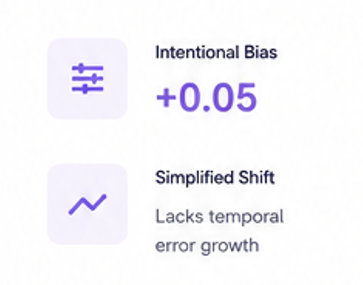
The current implementation generates the background field by adding a fixed constant (intentional_bias) to the ground truth, effectively resulting in a simple parallel shift: raw_background = raw_true_val + intentional_bias. However, in real-world Numerical Weather Prediction (NWP) models, errors accumulate over time, often causing the predicted path’s shape to diverge from the actual trajectory. This fixed-bias approach lacks the dynamic, time-dependent error growth seen in operational forecasting, which may oversimplify the correction task for the filter.
About Condition Setting
📊
Confidence Weighting in EnKF
The EnKF’s reliability is governed by the relative variance of its inputs. Currently, the observation error (LSTM), R_std, is set to 0.03, while the background error, Q_std, is 0.05. This configuration results in a Kalman Gain (K ≈ 0.73) that forces the filter to trust LSTM predictions approximately three times more than the background field. While this prioritizes the deep learning model, it creates a high dependency on LSTM performance. If the LSTM produces a biased or outlier prediction, the filter lacks the corrective “anchor” from the background field to mitigate the error, potentially leading to over-fitted or unstable results.

🌪️
Missing Environmental Steering Flow
Tropical cyclones do not move independently; their tracks are strongly influenced by surrounding atmospheric flows such as the subtropical high, mid-latitude westerlies, and upper-level jet streams. However, the LSTM model in this study was trained only with storm-centered variables, including latitude, longitude, central pressure, wind radius, velocity components, and translation speed. As a result, the model could learn the past motion and internal characteristics of the typhoon, but it could not recognize the external atmospheric forces that cause recurvature or acceleration during the decaying stage. Therefore, when the typhoon approached the missing-data point, the model tended to extend the previous motion linearly toward the northeast rather than dynamically responding to changes in the surrounding pressure and wind fields.

About Model
🔄
Autoregressive Error Accumulation
A key limitation of this experiment is that the model uses an autoregressive rolling-window structure, where each LSTM prediction is repeatedly fed back into the next input sequence. Since the EnKF-corrected value was not used as the next input, small errors in the LSTM prediction were carried forward and gradually amplified over time. As a result, once the predicted track began to deviate toward the northeast, the following predictions continued in the same direction, causing the model to follow an inertial straight path rather than fully capturing the recurvature during the typhoon’s dissipation stage.
